The need
In a competitive installation market, not knowing what a competitor offers in front of a prospect can directly cost a deal. Yet competitive knowledge had four weaknesses: it was scattered across Slack, Notion, email and people’s heads, unevenly shared, stale within months, and unused by Marketing.
What I owned
The research agent, the web application and everything that keeps them running. The first version was a Claude project with a separate app. I then rebuilt it as the case study of the Ops Agent, because a system prompt has no versioning or review, and an app nobody monitors eventually breaks without anyone noticing.
The solution
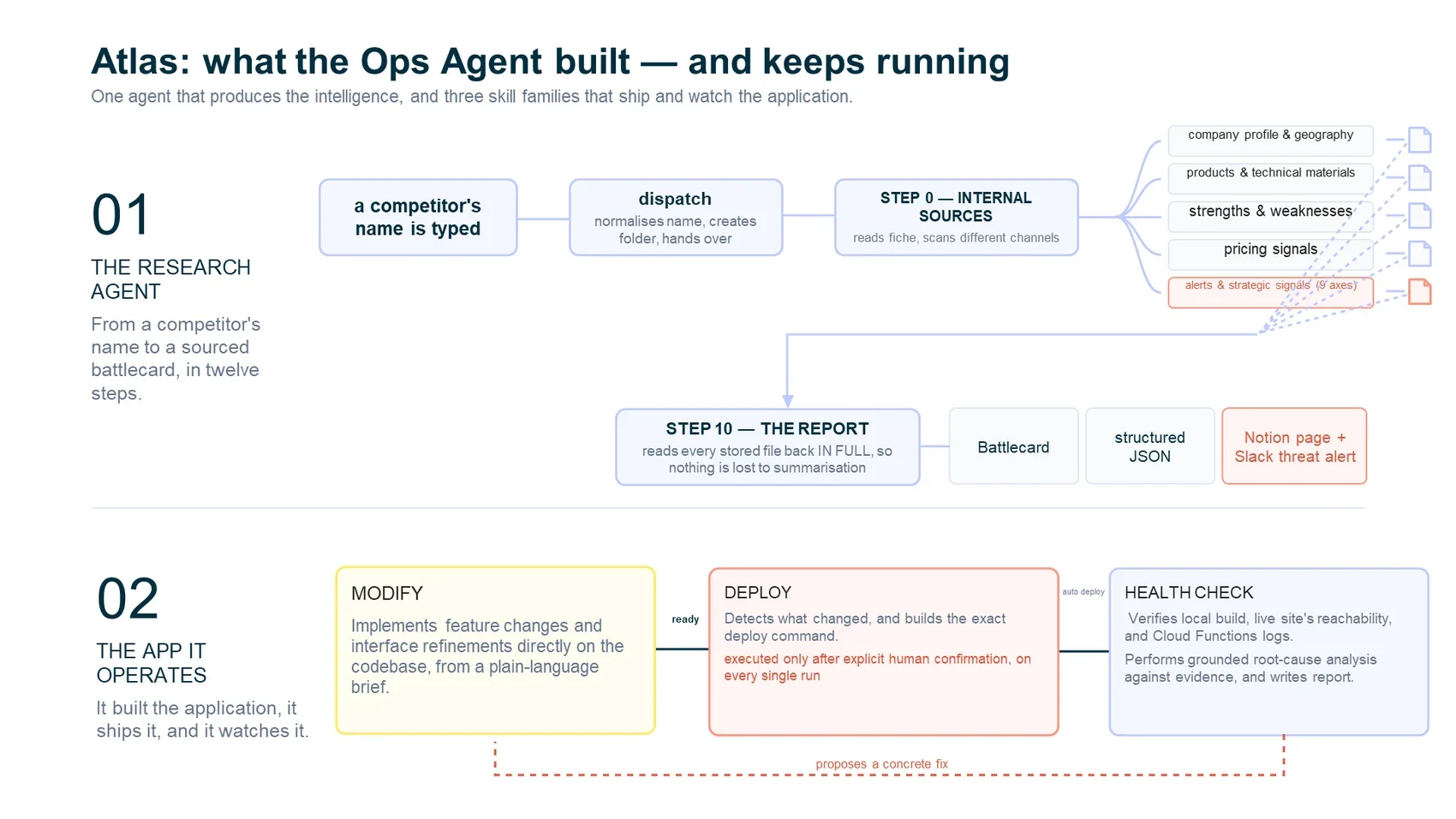
Atlas has two halves: a competitor analysis agent that gathers the intelligence, and a web app with AI strategic analysis that any Sales or Marketing user can read without opening a raw file.
The agent follows strict rules. It never invents a value, marks a field “not found” only after two failed search rounds, ties every fact to a source, and flags conflicts between sources.
Key modules
Competitor names and details are blurred in these screenshots.
Competitor grid
One card per competitor, with a threat gauge, area of operation on a France map, entry price and a two-sentence AI summary.
Competitor detail
The full battlecard: strengths and weaknesses, commercial strategy, products, pricing and reputation, all sourced.
AI strategic analysis
Gemini turns each competitor into a ranked list of competitive gaps, each paired with a Sales, Marketing or Product action.
Alerts centre
Aggregates market signals and separates direct threats from items merely to watch.
How it was built
The Ops Agent owns the application’s whole lifecycle through three families of skills:
- Modification skills apply feature changes from a plain-language brief.
- A deployment skill works out what changed, builds the exact Firebase command and runs it only after explicit human confirmation.
- A health-check skill is read-only. It verifies the build, the live site and the logs, then proposes a fix but never applies one itself.
Results
- Deployed on Firebase and in active use by Sales and Marketing.
- Competitor knowledge that was fragmented and stale is now centralised and fully sourced. Sales open a fiche before a meeting, and Marketing uses the fiches for comparative content.
- A real run took about 28 minutes sequentially, and produced 39 source labels and 51 URLs across 1,510 lines.