The need
Neural networks often have to run on embedded devices with little memory and compute. Can a network be shrunk heavily without losing what makes it useful, and how far can it go?
What I owned
Training, the pruning and quantization experiments, and the analysis, in a team of two.
The solution
Train
ResNet-18 on CIFAR-10Cosine learning rateAugmentation
Prune
L1 global unstructuredConvolution and linear layersSeveral pruning amounts
Fine-tune
10 epochs to recalibrate
Quantize
Post-training INT8Calibration on CIFAR-10
How it was built
Pruning was tested over a range of amounts to find where accuracy breaks. At 98%, about 233,000 non-zero parameters remain, out of about 11.2 million. Accuracy holds up remarkably well until the most aggressive levels, thanks to fine-tuning.
Results
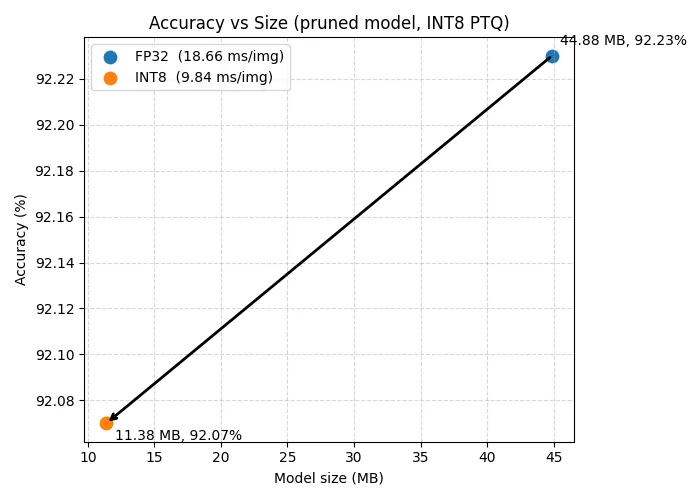
Pruning removes parameters, but it does not shrink a stored file on its own, since the zeros still take up space. Quantization delivers the file size and speed gains:
- Size: 44.9 MB to 11.4 MB, which is 25.4% of the original.
- Latency: 18.66 ms to 9.84 ms per image, which is 52.7% of the original.
- Accuracy: 92.23% to 92.07%, which is 99.8% of the original.